
When Circularity Backfires
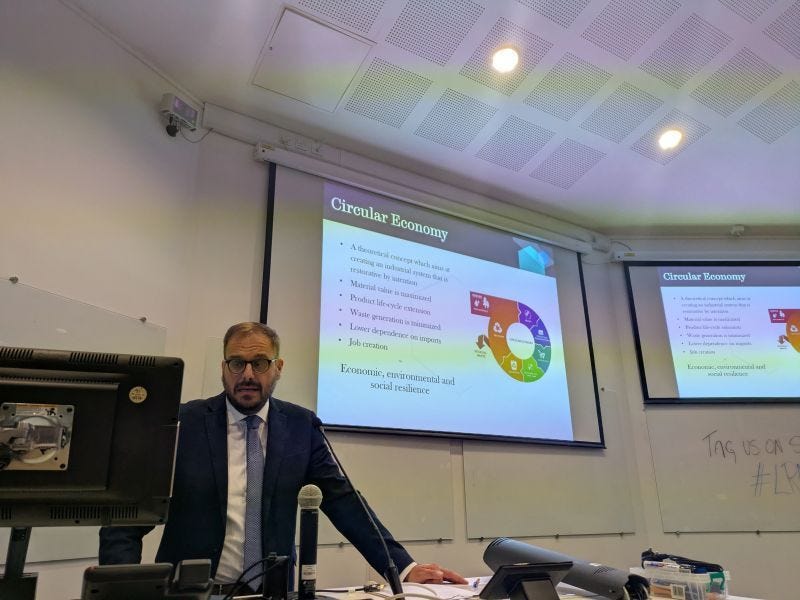
Last week I spoke at the annual Logistics Research Network conference, arranged by my colleague Dr. Erica Ballantyne, where I was kindly invited to give a keynote on the circular economy and its implications for supply chains and logistics. My talk was titled: “Is circular always sustainable?”.
The circular economy (CE) has become one of the dominant narratives of our times. From EU policy documents to glossy corporate sustainability reports, CE is celebrated as the strategy to decouple economic growth from environmental harm. Its promise is seductive: closed loops, efficient resource use, and the end of waste. Logistics, in this story, is cast as the enabler – reverse flows, remanufacturing, resource sharing, reuse.
But the reality is more complicated. My argument was simple: circularity does not automatically equal sustainability. In fact, under the current growth-driven system, CE measures often generate rebound effects that can increase environmental impact rather than reduce it.
I illustrated this with several case studies from specific industries, where the logistics footprint expands as new “circular” services are layered on top of – rather than displacing – primary production. The rebound is not an accident, but a feature, often even a desirable one: CE under capitalism often opens up new markets and niches, “growing the pie” instead of shrinking it.
So what does this mean for logistics? It means the sector cannot treat CE as just another optimisation challenge. Firm-level efficiency tweaks won’t cut it. Instead, we need system-level planning that asks harder questions:
- Are circular practices actually displacing virgin production?
- Are loops being shortened, not lengthened?
- Can reverse flows be consolidated, standardised, and planned collaboratively rather than left fragmented?
My conclusion was that logistics is pivotal. It can either amplify the rebound — by scaling up inefficient, growth-driven CE models — or mitigate it, by designing shorter loops, supporting sufficiency, and aligning with ecological limits.
CE talk is everywhere. But unless we bring rebound effects and logistics realities into the conversation, we risk mistaking circular branding for genuine sustainability.
