
Circular Supply Chains: Beyond the Hype, Into the Trade-offs
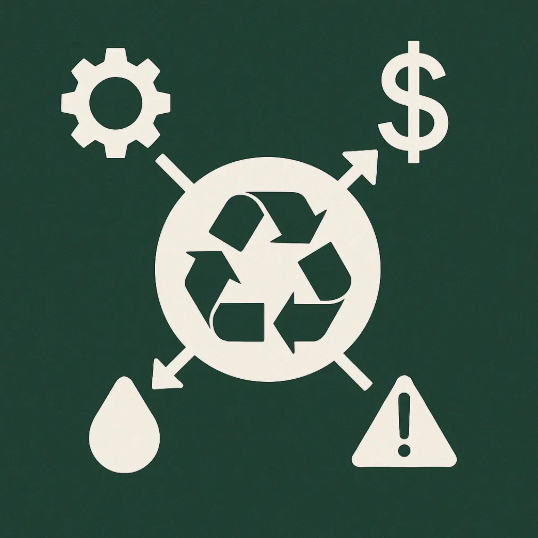
Designing effective supply chains means confronting real-world frictions that disrupt the elegant simplicity of circular economy rhetoric.
♻️ The idea of a circular supply chain (CSC) is seductive: products that are reused, remanufactured, recycled, and kept in the loop for as long as possible. Waste disappears, virgin resource extraction plummets, and business models become both sustainable and profitable.
But when we move from vision to implementation, things get messy.
In our recent paper, published in Annals of Operations Research (with Azar MahmoumGonbadi and Antonino Sgalambro), we argue that designing effective CSCs means confronting real-world frictions that disrupt the elegant simplicity of circular economy (CE) rhetoric.
The promise… and the tension
Circular Economy principles urge companies to embrace what we call the R-imperatives: reuse, remanufacture, recycle. Intuitively, the more of these loops we activate, the better: longer product lifecycles, less landfill, and more value retained.
But CSCs don’t operate in a vacuum. They are embedded in markets, infrastructures, and organisations that are rife with competing demands. The logistics of moving products back into circulation, the economics of pricing refurbished items, and the politics of allocating resources all create tensions that theory alone cannot resolve.
Three key trade-offs
Our work identifies and models three particularly thorny trade-offs:
- Circularity vs. Complexity
- More downgraded markets and R-imperatives improve resource efficiency, but they add operational costs and logistical complexity. A perfectly closed loop can be too costly to manage.
- Revenue vs. Cannibalisation
- Selling recovered products creates new revenue streams. But those same products may cannibalise sales of new items, raising difficult questions about profitability and product positioning.
- Sustainability vs. Sustainability
- Ironically, pushing “circularity” too hard in one area can reduce sustainability in another. For example, excessive remanufacturing may demand more energy and logistics, offsetting environmental gains.
Our approach
To explore these trade-offs, we built a bi-objective optimisation model that helps decision-makers design CSCs while explicitly accounting for:
- Facility locations and product flows
- The number of downgraded markets to activate
- Cannibalisation effects between recovered and new products
- Waste minimisation vs. profitability goals
Using the AUGMECON2 optimisation method, we identified Pareto-optimal solutions – scenarios where you cannot improve on one objective (profit or waste reduction) without making the other worse.
This approach shifts the conversation: instead of chasing the illusion of a perfectly circular supply chain, we show that the real challenge is to navigate the Pareto frontier of trade-offs.
Why it matters
The message is clear: circularity is not a free win.
- Policymakers must recognise that legislation promoting circularity needs to grapple with market realities, especially cannibalisation risks and coordination challenges.
- Businesses need to move past “circular-washing” and confront the real costs and benefits of activating different R-imperatives.
- Scholars should engage more critically with the frictions of CE, not just its ideals.
In short, the transition to circular supply chains isn’t just about closing loops. It’s about making strategic choices in the face of unavoidable tensions, choices that will differ by industry, product, and market context.
Open questions
This research leaves us (and hopefully you, the reader) with some pressing questions:
- How should firms weigh short-term cannibalisation risks against long-term sustainability gains?
- Are businesses equipped to manage the logistical and strategic complexity of multi-level circular supply chains?
- How can resource allocation and coordination be improved when so much of it still happens in an ex-post fashion, after problems arise rather than proactively?
