
Tariffs and turbulence: a view from the frontline
An interview with Leo Nucera, Sales & Marketing Director of a leading Italian exporter of food products in the US
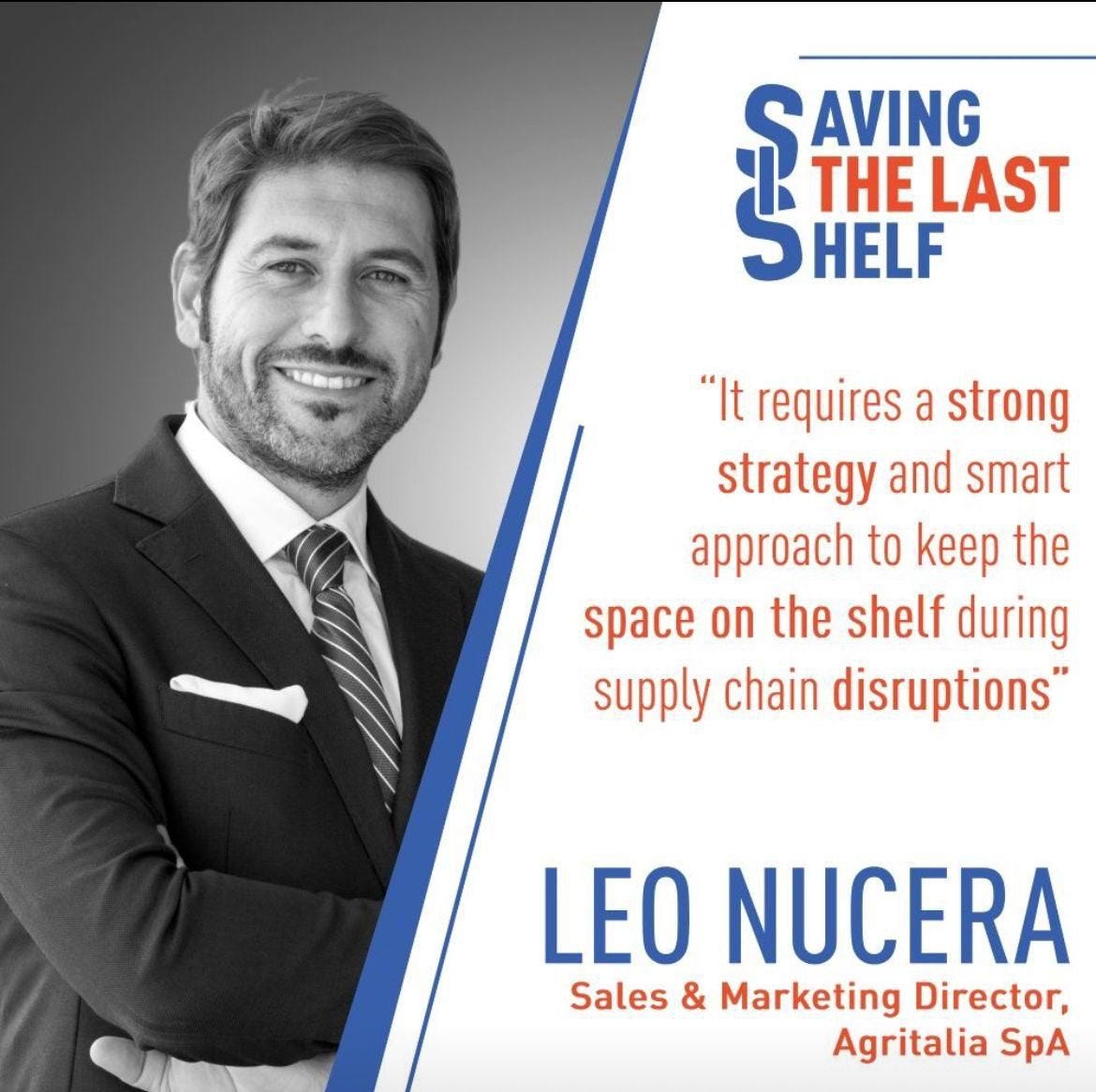
I had the pleasure to have a short chat with my friend Leo Nucera, Sales & Marketing Director at Agritalia, a key player in the distribution of Italian premium food products across the United States. Recognised by Forbes Italia as one of Italy’s “Top 100 Marketing Directors”, Leo brings a rare combination of deep industry expertise, strategic vision and hands-on experience navigating one of the most challenging export environments. In this brief interview, he shares insights from the frontline of the U.S. market, discussing how tariffs, shifting logistics costs and evolving consumer expectations are reshaping the business of Italian food abroad, along with supply chain implications.
AG: In recent years, the implementation of tariffs by the US administration has had a significant impact on the export of European food products to the United States. How did your company react to this new scenario?
Leo: Tariffs are paid directly by the importer, who is responsible to the US government. In our case, it was our American company, AGRUSA, that had to deal with these costs upfront. We could not immediately pass them on to customers, because most of our price list has a 90-day policy for price changes. This ensures that products already on the market at the old price are sold before introducing new prices. This pricing rigidity made managing the increases very complex.
We experienced a domino effect in negotiations with clients. Tariffs were also very volatile: on April 4 they rose to 20 percent, then briefly dropped to 10 percent for 90 days, then on July 7 they went up to 30 percent. Later, thanks to negotiation between the United States and the European Union, they were reduced to 15 percent. Throughout this period there was major uncertainty. It was unclear whether tariffs would apply to goods already in transit, and many shipments had to wait for clarifications or exemptions.
Tariffs are calculated on the cost of production, so a 15 percent tariff equals roughly a 12 percent increase on the selling price. There were huge investments to keep continuity of the supply chain, reliability of supply is our top priority. On top of that, the euro strengthened, making Italian products even more expensive in US dollars. Not an ideal scenario, for us.
The US market represents 80 percent of our turnover, so guaranteeing continuity of supply was absolutely critical. We involved the entire supply chain, from suppliers to distributors, to maintain constant product availability. We are still licking our wounds today, but we managed to stay on shelf. The real effects on retail prices, however, will be probably visible only in 2026, when retailers will be able to update price lists on shelf.
AG: Did you have to modify your logistics network or operational strategies due to the tariffs?
Leo: Not in a substantial way. Before the tariffs came into force, at the end of 2024, we decided to anticipate some shipments, building up extra inventory in the United States to mitigate the impact. It was a precautionary measure, but the overall logistics model remained unchanged.
AG: How did you manage pricing and margins?
Leo: Especially in the private label segment, margins are already very low, in the low single digit range! With tariffs, the actual margin drops even further! It has become a time not only to select suppliers in a careful way, but also to select clients in the same way: we need to understand who is willing to collaborate and who would switch supplier for a few cents.
At the moment there has not been a dramatic impact, but we expect that in 2026 inflation will push for efficiencies. Some suppliers have been cooperative in finding shared solutions, others less so; we can say the same for customers.
AG: Are Italian suppliers considering alternative strategies?
Leo: Yes, some are evaluating production relocation for more standard products, such as commodities available in the US. However, these are costly and long term decisions, because no one knows how long this phase will last. Are we sure such policies will be still in force in four years? In recent years we have faced many other crises: poor olive harvests, unfavorable exchange rates, the challenge of the Suez and Panama canals that sent transport costs skyrocketing. Everything depends on demand elasticity. For commodity-type products, these choices are very risky.
Through our subsidiary AGRUSA, we also support local suppliers, working on domestic production programs. There is strong interest in understanding how to optimize the supply chain, for example by eliminating unnecessary stops of the goods (i.e. storing in public US warehouses) to reduce costs and partially offset the effect of tariffs. This is something that our logistical model allows us to do.
AG: Looking ahead, how do you evaluate the regulatory and political outlook?
Leo: It is difficult to make predictions. Everything will depend on how US-EU trade relations evolve. In any case, we are working on contingency plans and on greater geographical diversification. Industry associations can also play a role in negotiating more stable conditions, but for now the priority remains managing daily uncertainty.
AG: From a consumer perspective, have you noticed significant changes in the US market?
Leo: In some categories it is becoming challenging to import. Margins are low and local competition is strong. However, especially among younger consumers, attention to quality, authenticity, healthfulness and ethics is growing. This still gives nice space for to premium Italian brands.
A good example is ready-to-use sauces: products that highlight Italian raw materials and convey an image of authenticity are growing strongly. Even lower-priced brands are losing market share to these alternatives. In other words, the perceived value of Italian origin remains a key competitive lever, even in a period of tariffs.
AG: Thank you very much, Leo, for sharing with Planned Obsessions these great insights!
